Move more · Routine
Tai Chi for Beginners
Slow, flowing moves for balance, calm and strong legs. You can do it in a living room.
HealthStylz Editors
· 3 min read
The short version
- Tai chi may help balance and prevent falls in older adults.
- It is gentle and appears to be safe.
- Do the moves slowly. You can hold a chair.
Balance & Flow
Mindful Balance & Fall Prevention Profile
Slow, rooted movements that strengthen ankle stabilizers and sharpen vestibular balance cues.
- Single-Leg StabilityAnkle & hip control +48% balance
- Fall Risk ReductionClinical protection -43% fall risk
- Joint Synovial CirculationGentle fluid lubrication Supple joints
- Breath-Movement HarmonyNeuroplastic focus Dual-task ease
Source: Cochrane Database of Systematic Reviews & Harvard Health Publishing.
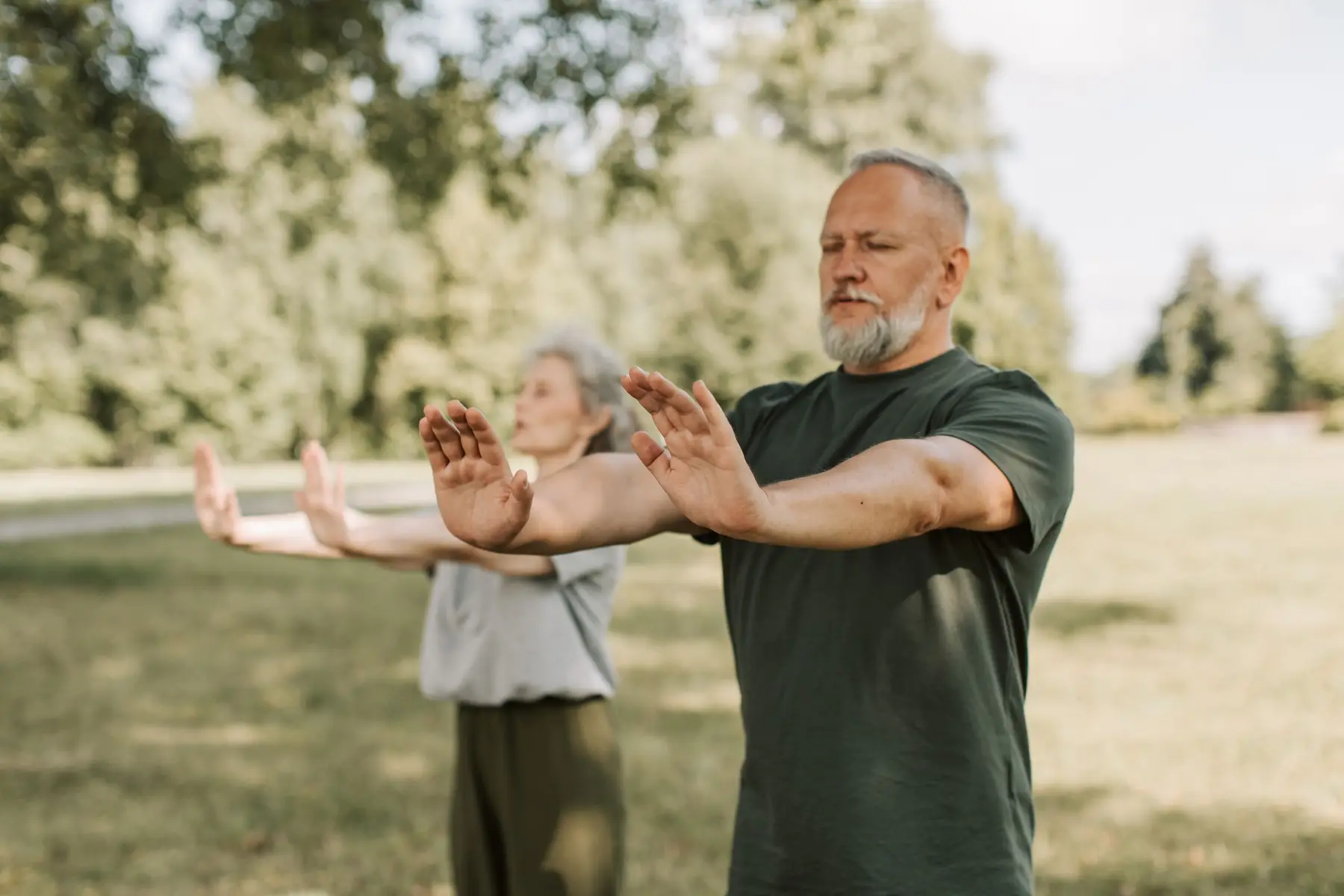
Tai chi looks like a slow dance. It is a gentle practice with slow moves, calm breathing and a quiet mind. It began as an ancient Chinese martial art. Today people use it for health.
What the research says
The NIH's center for complementary health (NCCIH) says tai chi may help balance and help prevent falls in older adults and people with Parkinson's disease. For knee arthritis, it says evidence of low to moderate strength shows less pain and stiffness and better movement. Guidelines from the American College of Rheumatology and the Arthritis Foundation strongly recommend it for knee and hip arthritis. NCCIH says it is not known whether tai chi helps people who have had a stroke or who have heart failure.
Is it safe?
NCCIH says tai chi appears to be safe. In a review of 24 studies, harm was about as common as with other activities or none. The problems reported were minor, like sore muscles or joints.
Getting started
- Wear flat, comfy shoes or go barefoot on a non-slip floor.
- Stand near a chair or counter if your balance is shaky.
- Move slowly. Never force a stretch.
- Do these moves 2 or 3 times a week to start.
- If you join a class, ask the teacher about their training. NCCIH says there is no license or national standard for tai chi teachers.
What a first class looks like
Tai chi mixes slow movement, a calm mind and controlled breathing. Ask about the teacher's training and watch a class before you sign up.
A four-week start
- Week 1: Practice the first three moves for 5 minutes, 2 days.
- Week 2: Add the cloud hands move, 3 days.
- Week 3: Do all six moves for 10 to 15 minutes, 3 days.
- Week 4: Repeat the whole set twice, or join a class.
Safety
Check with your doctor first if you have dizzy spells, bad balance, or joint problems. Do not use tai chi in place of seeing a health provider about a medical problem. Tell your providers about any new practice you try.
The moves
- Root and breathe 1 minute
Stand with feet shoulder-width apart and knees soft. Let your arms hang. Feel your feet on the floor. Breathe in slowly through your nose and out through your mouth. Take 6 breaths.
- Rising and sinking arms 2 minutes
Breathe in as you lift both hands to shoulder height, palms down. Breathe out as you bend your knees a little and lower your hands. Keep your shoulders loose. Repeat 8 times.
- Weight shift 2 minutes
Stand with feet a little wider than your hips. Slowly shift your weight onto your right foot. Then shift to the left. Move like you are pouring water from one side to the other. Do 10 slow shifts.
- Wave hands like clouds 3 minutes
Shift your weight to the right as your right hand drifts up and your left hand moves down. Then shift to the left as your hands swap. Let your eyes follow the upper hand. Do 8 sets.
- Slow step forward 3 minutes
Shift your weight to your left foot. Lift your right heel and slowly place it a step ahead. Roll weight forward onto it. Step back. Hold a chair if you need. Do 5 per side.
- Closing breath 1 minute
Raise both arms in front of you as you breathe in. Lower them as you breathe out. Rest your hands low on your belly. Stand quietly for 3 breaths.
Stop if anything hurts. If you have a health condition or are new to exercise, check with your doctor first.